Prescriptive vs Performance Title 24: What's the Difference and Which One Do You Need?
If you're building an ADU, home addition, or remodeling your house in California, you've probably heard you need Title 24 energy compliance to get a building permit. What many homeowners don't realize is that there are two different ways to meet Title 24:
- Prescriptive compliance
- Performance compliance
Let's break these down in plain English and help you understand which one makes sense for your project.
What Is Title 24, in Simple Terms?
Title 24 is California's energy code. It sets rules for things like:
- Insulation
- Windows
- Heating and cooling systems
- Water heaters
- Lighting
- Sometimes solar
Cities and counties require proof that your project meets these energy rules before they issue a building permit. That proof usually comes in the form of a Title 24 energy report.
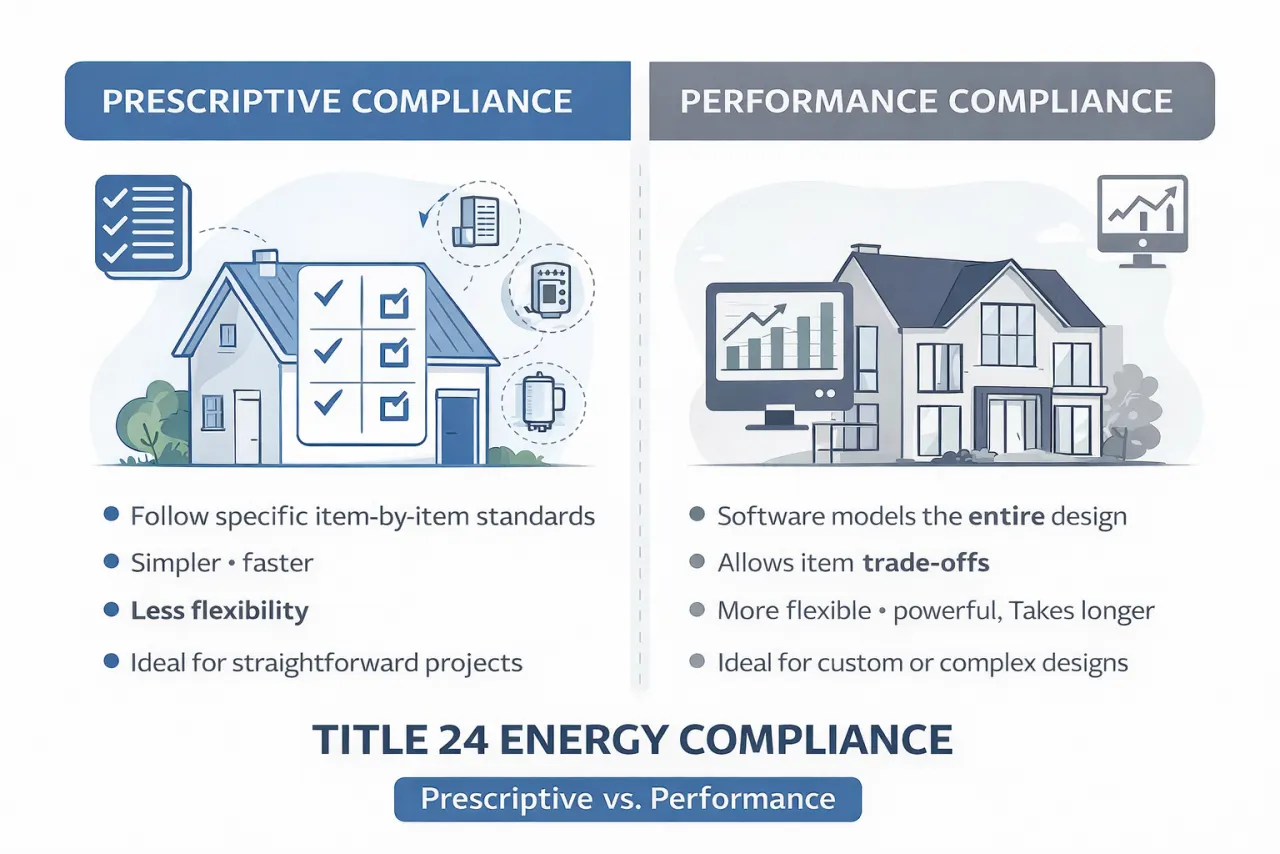
At a glance: how prescriptive and performance compliance compare for your California project.
Option 1: Prescriptive Compliance (The Checklist Way)
Think of prescriptive as a checklist.
With this method, each part of your project must meet specific minimum requirements. For example:
- Your walls must have at least a certain amount of insulation
- Your windows must meet certain efficiency ratings
- Your HVAC system must meet minimum efficiency standards
If every item on the list meets the rules, your project passes Title 24.
Pros of Prescriptive
- Simpler and faster
- Easier to understand
- Usually cheaper for small or simple projects
- Great for straightforward additions, ADUs, and standard remodels
Cons of Prescriptive
- Less flexible
- If one item doesn't meet the rule, you may have to redesign it
- Not ideal for custom designs or lots of glass/windows
Option 2: Performance Compliance (The Whole-Home Way)
Think of performance as looking at the whole house together instead of a checklist.
With this method, energy software models your design and checks how the home performs overall. This allows trade-offs. For example:
- Bigger windows? You might need better insulation elsewhere
- Want a certain design feature? You can make up for it with more efficient systems
As long as the total energy performance meets the target, your project can pass—even if some parts don't meet the standard checklist values.
Pros of Performance
- Much more design flexibility
- Great for custom homes, modern designs, or lots of windows
- Helpful for complex additions or ADUs
- Lets you optimize for cost, comfort, or design
Cons of Performance
- More complex
- Usually costs more
- Takes a bit longer because it requires energy modeling
So… Which One Should You Use?
Here's the simple rule of thumb:
Use Prescriptive if…
Your project is simple and standard — basic ADU, straightforward addition, typical remodel.
Use Performance if…
Your project is custom or design-heavy — lots of windows, unique layouts, tight site constraints, or modern designs.
In many cases, your designer or energy consultant will quickly tell you which path makes more sense based on your plans.
Do Both Methods Still Have Rules?
Yes. No matter which method you use, some rules are mandatory—for things like ventilation, certain equipment standards, and basic safety and efficiency requirements. You can't trade those away under either method.
The Bottom Line
Both paths get you to the same place: a permit-ready Title 24 energy compliance report.
- Prescriptive = simpler, faster, more rigid
- Performance = more flexible, more powerful, slightly more complex
The best choice depends on your design, your goals, and your budget.
Planning an ADU or Addition?
Get a free quote for your ADU, addition or remodel. Title 24 compliance is prepared in-house and included in our permit sets; we do not accept standalone report requests.
Get Your Free Quote